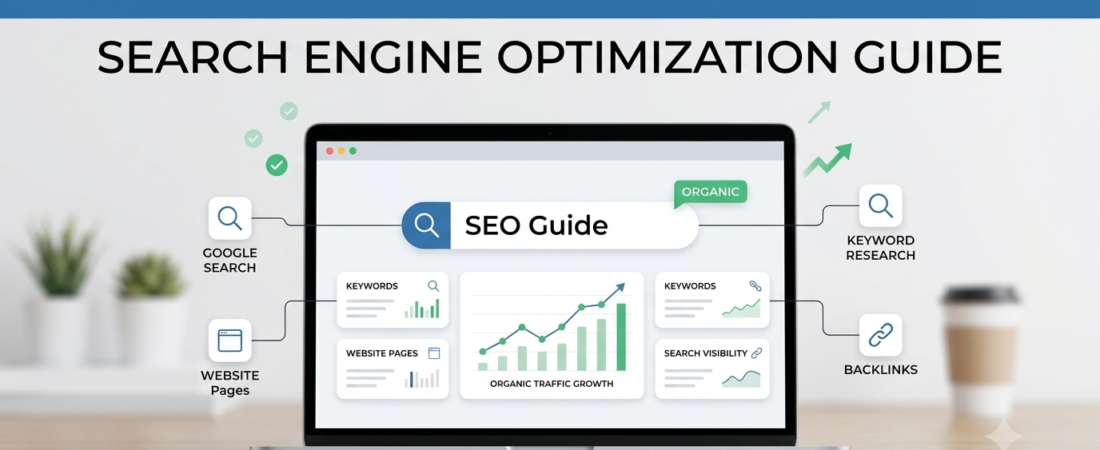
If you have a website, blog, online store, or small business, Search Engine Optimization (SEO) can help more people discover your content through search engines such as Google.
In simple terms, SEO is the process of improving your website and its content so that search engines can better understand it and users can more easily find useful information.
SEO is not about adding keywords everywhere or trying to trick Google into ranking your website. Good SEO starts with useful, reliable, people-first content and a website that search engines can discover and understand.
In this beginner-friendly guide, we’ll explain what SEO is, how it works, the main areas of SEO, and practical ways small businesses and website owners can improve their search visibility.
What Is SEO?
SEO stands for Search Engine Optimization.
It refers to the practices used to help search engines discover, understand, and present your website and its content in relevant search results.
For example, imagine you run a small business that sells handmade products.
Someone searches Google for:
“best handmade gifts for small businesses”
If your website contains a useful, relevant page about this topic, SEO can help search engines understand what the page is about and determine whether it may be useful for that search.
SEO does not guarantee a specific ranking or a certain amount of traffic. Instead, it helps create better conditions for your website to be discovered and understood.
Quick Answer: How Does SEO Work?
SEO can be understood through three basic stages:
1. Crawling
Search engines discover webpages through links and other mechanisms.
2. Indexing
Search engines analyze and store information about webpages that are eligible to be indexed.
3. Ranking and serving results
When someone searches, search engines use many signals to determine which relevant results to show.
Your job as a website owner is to make your website:
- Easy for search engines to discover
- Easy to understand
- Relevant to the searcher’s needs
- Useful and trustworthy
- Easy for people to navigate and use
Why Is SEO Important for Small Businesses?
For a small business, SEO can be especially useful because it can help people discover your website when they are already searching for information, products, or services related to your business.
For example, a small business might target searches such as:
- AI tools for small businesses
- freelance services for startups
- best productivity tools for small teams
- how to automate small business tasks
- website tools for entrepreneurs
Instead of relying only on paid advertising or social media, SEO can help you build a source of organic search traffic over time.
However, SEO usually requires patience. A new website should not expect to rank immediately for highly competitive keywords.
The 4 Main Areas of SEO
SEO is often divided into several areas. For beginners, four categories are especially useful to understand.
1. On-Page SEO
On-page SEO focuses on the content and elements of individual webpages.
Examples include:
- Page titles
- Headings
- Main content
- Keyword usage
- Internal links
- Image descriptions
- URLs
- Meta descriptions
The goal is not to repeat a keyword as many times as possible.
Instead, your page should clearly communicate what it is about and satisfy the user’s search intent.
2. Technical SEO
Technical SEO focuses on the technical parts of a website that can affect crawling, indexing, and usability.
Examples include:
- Website structure
- Mobile usability
- Page loading performance
- Crawlability
- Indexing
- XML sitemaps
- Robots.txt
- HTTPS
- Canonical URLs
- Structured data
You do not need to become a developer to understand basic technical SEO.
For many small websites, keeping the website technically clean, well-structured, and easy for search engines to access is a good starting point.
3. Off-Page SEO
Off-page SEO refers to activities and signals that happen outside your own website.
One commonly discussed example is backlinks.
A backlink occurs when another website links to your website.
For example:
Another website publishes an article about AI tools and links to your guide on Smart Digital Hub.
That link is a backlink.
However, more backlinks do not automatically mean better SEO.
Relevant, trustworthy links can be much more valuable than large numbers of low-quality or unrelated links.
Other activities that can support visibility include digital PR, partnerships, industry mentions, and creating useful resources that other websites naturally want to reference.
4. Local SEO
Local SEO is particularly important for businesses that serve customers in a specific geographic area.
Examples include:
- Restaurants
- Local service providers
- Repair businesses
- Clinics
- Consultants
- Local stores
Local SEO can involve your Google Business Profile, local business information, reviews, location-related content, and consistent business details across relevant platforms.
If your business serves customers internationally or operates entirely online, local SEO may be less important than other SEO areas.
SEO vs. AIGEO: What’s the Difference?
Traditional SEO focuses heavily on helping search engines understand and surface webpages.
AIGEO, or AI Engine Optimization, focuses on making information easier for AI-powered search and answer systems to understand, retrieve, summarize, and potentially cite.
For example, an SEO-friendly article may target:
“What are the best AI tools for small businesses?”
An AIGEO-friendly article should also provide:
- A clear answer near the beginning
- Well-defined concepts
- Structured sections
- Comparison tables
- Direct answers to common questions
- Specific facts and explanations
- Clear relationships between concepts
The two approaches can work together.
A useful article should first help the reader. Then SEO and AI-search optimization can make the information easier for search systems to understand.
How to Do SEO for a Small Business Website
You do not need a huge SEO budget to start.
Here is a practical beginner workflow.
Step 1: Understand Your Audience
Before choosing keywords, understand what your customers actually want.
Ask:
- What problems do they have?
- What questions do they search for?
- What products or services are they comparing?
- What information would help them make a decision?
Good SEO starts with understanding people, not keywords.
Step 2: Find Relevant Keywords
Keyword research helps you understand the language people use when searching.
For example, instead of targeting only:
“AI”
a small business website might target more specific searches such as:
“AI tools for small businesses”
or:
“best AI tools for small business marketing”
Specific keywords often make it easier to create focused content.
Step 3: Create Helpful Content
Create content that genuinely answers the question behind the search.
For example, if someone searches:
“How can a small business use AI?”
a useful article could explain:
- Customer service
- Content creation
- Marketing
- Research
- Productivity
- Automation
- Data organization
Do not simply repeat the keyword throughout the article.
Add explanations, examples, comparisons, and practical advice.
Step 4: Optimize the Page
For each important page, review:
- SEO title
- H1 heading
- H2 and H3 headings
- URL
- Meta description
- Internal links
- Images
- Image ALT text
- Main content
Make sure the page clearly communicates its purpose.
Step 5: Build Internal Links
Internal links connect pages on your own website.
For example, an article about SEO could link naturally to:
- AI Tools
- Marketing Automation
- Small Business Solutions
- Productivity Tools
Internal linking can help visitors discover related information and can also help search engines understand the relationship between pages.
For a more detailed explanation of SEO fundamentals, start with our [SEO for Beginners: A Practical Guide to Search Engine Optimization]. If you want to improve your small business website step by step, read our [How to Do SEO for a Small Business Website: A Practical Guide].
Step 6: Earn Relevant Backlinks
Want to learn more about link building? Read our [How to Get Backlinks for a New Website: A Practical Guide] for practical ideas on earning relevant backlinks.
Backlinks can help your website become more discoverable and can contribute to your site’s authority.
Instead of trying to get hundreds of random links, focus on creating resources that other websites would genuinely find useful.
Examples include:
- Original research
- Useful guides
- Statistics
- Checklists
- Templates
- Calculators
- Industry resources
- Expert explanations
You can also explore legitimate blogger outreach, guest posting, digital PR, and partnerships.
Be careful with services promising thousands of backlinks for a very low price. Large quantities of irrelevant or low-quality links are not a substitute for useful content and legitimate website promotion.
SEO Tools Beginners Can Use
You do not need dozens of expensive tools to start.
A basic SEO toolkit can include:
Google Search Console
Google Search Console can help website owners understand how their websites perform in Google Search and identify indexing-related issues.
It is one of the most useful free tools for a new website.
Google Trends
Google Trends can help you explore search interest and compare topics over time.
It can be useful when deciding which content topics are worth researching further.
SEO Plugins
If you use WordPress, an SEO plugin can make it easier to manage common SEO settings such as:
- SEO titles
- Meta descriptions
- XML sitemaps
- Social sharing information
- Schema-related settings
An SEO plugin does not automatically make a website rank well. It simply makes many technical and on-page tasks easier to manage.
Common SEO Mistakes to Avoid
Keyword Stuffing
Repeating the same keyword unnaturally can make content difficult to read.
Write for people first.
Writing Only for Search Engines
If an article exists only to attract search traffic but does not genuinely help readers, it is unlikely to provide long-term value.
Google explicitly recommends people-first content rather than content created primarily to manipulate search rankings.
Publishing Large Amounts of Low-Value AI Content
AI can help with research, organization, and drafting, but automatically generating large amounts of content without adding useful value can create problems.
Use AI as a tool, not as a replacement for judgment, research, editing, and original value.
Buying Cheap Backlinks in Bulk
Thousands of backlinks may sound attractive, but SEO is not simply a numbers game.
Focus on relevance, quality, and genuine value.
Expecting Fast Results
SEO is usually a long-term strategy.
A new website may need time to be crawled, indexed, understood, and evaluated through search systems.
Instead of asking only:
“How quickly can I rank?”
ask:
“How can I build a website that becomes more useful and trustworthy over time?”
How Long Does SEO Take?
There is no universal timeline.
Results can depend on factors such as:
- Website age
- Competition
- Search intent
- Content quality
- Website structure
- Existing authority
- Backlinks
- Technical issues
- Search demand
- Consistency
A new website should focus on building a strong foundation rather than expecting immediate first-page rankings.
Track progress through impressions, clicks, indexed pages, rankings, and relevant conversions.
SEO Checklist for Beginners
Before publishing an important page, check:
- Does the page answer a real user question?
- Is the search intent clear?
- Is the main topic obvious?
- Does the title accurately describe the page?
- Is there one clear H1?
- Are H2/H3 headings useful?
- Are relevant keywords used naturally?
- Does the page link to related content?
- Are images optimized and given useful ALT text?
- Can Google crawl and index the page?
- Does the page provide something useful beyond generic information?
- Are important claims supported by trustworthy sources?
- Would you recommend this page to another person?
Frequently Asked Questions About SEO
What does SEO stand for?
SEO stands for Search Engine Optimization. It refers to practices that help search engines discover, understand, and present relevant webpages to users.
Is SEO free?
SEO itself does not require paying Google for organic rankings. However, businesses may spend money on tools, professional services, content creation, technical development, or digital PR.
Can a small business do SEO itself?
Yes. Many small businesses can handle basic SEO themselves, especially keyword research, content creation, internal linking, Search Console monitoring, and basic on-page optimization.
More technical SEO or large-scale SEO campaigns may require specialist help.
Are backlinks still important for SEO?
Backlinks can still be useful, particularly when they come from relevant and trustworthy websites. However, SEO should not be reduced to collecting as many backlinks as possible.
Does AI-generated content hurt SEO?
Using AI does not automatically make content unsuitable for Google Search. The important issue is whether the content provides useful, accurate, original value and follows Google’s Search Essentials and spam policies.
How do I start SEO for a new website?
Start with a clear website structure, identify your audience and search topics, create genuinely useful content, connect related pages with internal links, monitor performance with Search Console, and gradually build your website’s authority.
Final Thoughts
SEO is not a single trick that makes a website rank on Google.
It is a long-term process of making your website easier to discover, understand, navigate, and trust.
For small businesses and online entrepreneurs, the best starting point is usually simple:
Understand your audience → create useful content → optimize your pages → connect related content → monitor results → improve over time.
As your website grows, you can gradually add more advanced SEO strategies such as technical SEO, content clusters, digital PR, structured data, and link building.
The goal is not simply to get more visitors.
The goal is to attract the right visitors and give them enough value that they want to stay, learn, and take the next step.
Sources and Further Reading
For current SEO guidance, Google Search Central’s official resources are a good starting point, including its SEO Starter Guide, Search Essentials, and documentation on creating helpful, reliable, people-first content.
Need Professional SEO Help?
If you are just getting started with SEO, you can handle many basic tasks yourself. However, technical SEO, link building, and larger SEO campaigns may require specialized skills.
If you prefer professional support, you can explore SEO freelancers on Fiverr for services such as on-page SEO, technical SEO, link building, and local SEO.
[Explore SEO Services on Fiverr →]
If you are just getting started with SEO, you can handle many basic tasks yourself. However, technical SEO, link building, and larger SEO campaigns may require specialized skills.
If you prefer professional support, you can explore SEO freelancers on Fiverr for services such as on-page SEO, technical SEO, link building, and local SEO.